2025–2026 SMART Goals
What I chose to officially work toward this year, with end-of-year progress.
2025–26 SMART Goals
| Specific | Measurable | Achievable | Relevant | Time-Phased | Support Required | SMART? | |
|---|---|---|---|---|---|---|---|
| Goal | Evidence of Progress | Actions | Connection | Timeframe | Support Required | SMART? | |
| Strategic Plan Goal | Skill up students and teachers with 3D printing and modelling, empowering them to tackle their own projects. | Display a growing amount of student work; document cases where teachers engage with the technology. | PD delivery, in-class lessons, 3D printing club, ongoing "special projects", assistance with K5 house project, general support. | Connects to the school's strategic goal of technology integration for teachers and students. | Autumn 2025 – Spring 2026. PD delivered to teachers on 21/10/2025. Students taught Fusion through Winter 2025–26. | New printers (delivered 19/10/25) and a generally supportive school attitude. | ✓ Yes |
| Self-Directed Goal | Develop enough skill with Arduino microcontrollers and coding to produce one or more "smart" products. |
Milestones:
|
Devote time to learning using physical materials and TinkerCAD tutorials. Produce a proof-of-concept assembly, design an enclosure and required parts. | Long-wanted skillset that can be directly applied to teaching once developed, enabling students to produce smarter products and advancing school technology integration. | October 2025 – March 2026. Proof-of-concept assembly targeted for completion by Christmas 2025. | None — all physical resources already in hand. | ✓ Yes |
Strategic plan linked goal: 3D printing at ISNS
Skill up students and teachers with 3D printing and modelling, empowering them to tackle their own projects.
using printers
taught Fusion
overhauled / revised
Semester 1
Teacher PD & engagement
Delivered 3D printing PD in October, then created the "ISNS Printers" chat — which grew to 12 staff actively using the printers at school.
Student instruction
Taught grades 10 and 11 advanced 3D modelling techniques. Students subsequently made independent use of printers for:
- MYP personal projects
- Other subjects across school
School projects
Personally designed and produced items for other teachers and school events, including microphone racks for Music and LED signage for Tech Week and the Chess Tournament.
3D printing club
Ran throughout the year — providing focused modelling instruction and giving students dedicated time to design and print their own creations outside class.
Semester 2
Grade 8 curriculum overhaul
Worked directly with Mr. Law to redesign grade 8's 3D modelling curriculum from the ground up, and supported students with questions throughout.
Grade 9 curriculum support
Assisted with revisions to grade 9's 3D modelling-based project.
Self-directed goal: microcontrollers
Develop enough skill with Arduino microcontrollers and coding to produce one or more "smart" products.
devices produced
web tool deployed
working macropad
Proof-of-concept devices
Classroom noise monitor
A real-time noise-level meter with a companion website that tracked how many times the "too loud" threshold was sustained for 3+ seconds. Used with younger students as a visual and numeric reminder — with measurable results in classroom volume.
Programmable macropad
A multifunction USB macropad built on an ESP32, with configurable buttons and inputs. Served as the direct inspiration for the student-facing configurator tool below.
Student tool
Macropad configurator
An all-in-one quick-start web tool for introducing students to ESP32 microcontrollers. Students drag and drop input components onto a microcontroller diagram, wiring auto-populates, and each component's function is user-defined. On export, the tool generates:
- A ready-to-use configuration file for the device
- A wiring diagram
- Step-by-step setup instructions
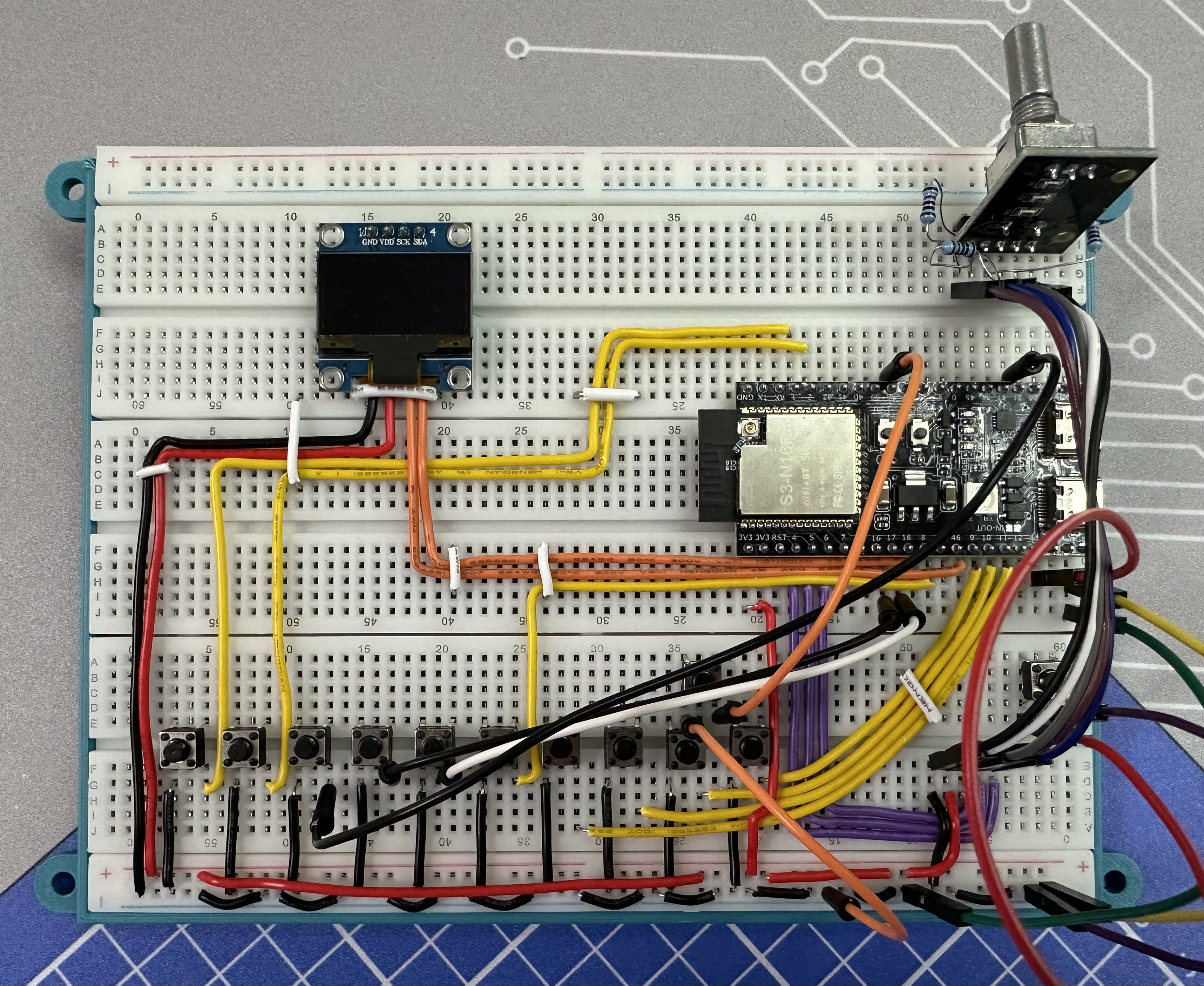
There have been a few "aha!" moments with microcontrollers, but the single biggest one was the revelation that I could work on projects and produce code with the help of AI. At the start this meant some things were flawless, but I spent a fair bit of time pasting error messages back to DeepSeek trying to troubleshoot things. As I've learned more of the coding languages myself I've needed to lean on AI less for simple troubleshooting, and pivoted to using it to create web interfaces and tools such as the macropad configurator.
My AI-assisted journey into microcontrollers has become an ongoing adventure over the past five months. ESP32 devices have Bluetooth and Wi-Fi, and can be used for all manner of home automation and Internet of Things projects. Exploring home automation led me to the idea that old hardware can be repurposed as a home server — for things like network-attached storage (my own OneDrive), locally hosted replacements for media streaming services, and even locally run LLMs. As someone who likes building computers, designing things, and learning about technology, creating my own small "datacenter" was too exciting a prospect to pass up. At present I have a cluster of three computers at home running different services on Proxmox, and I've learned a great deal about networking, servers, Linux, programming, and AI in the process.
I have a few things left to complete on that project, one of which is ESPHome — a hub for connecting and monitoring ESP32-powered devices. The project I'm most excited to begin involves using ESP32 cameras and local machine learning to build a cat identification device for my house. I might use it to dispense treats, or to collect data on where each cat spends their day — but more importantly, I now know where to begin and have the tools needed to see it through.